Thank you to the Public Safety Committee for holding this important hearing. It is critical that the Council continue to use its oversight power to hold the NYPD accountable to its obligations under the law.
Discriminatory policing is not a new problem. It’s been more than a decade since a federal judge ruled the use of Stop-and-Frisk unconstitutional, specifically citing racial bias and the disproportionate targeting of Black and Latino residents. It’s also been over a decade since the Council passed the Community Safety Act, which banned biased-based profiling by the NYPD. Yet Stop-and-Frisk practices persist; in fact, they have increased by 90% since Mayor Adams took office according to the Independent Monitor’s Compliance Report. Meanwhile, the New York Times reported in September that NYPD’s “discipline for illegal street detentions is lax at every level.”
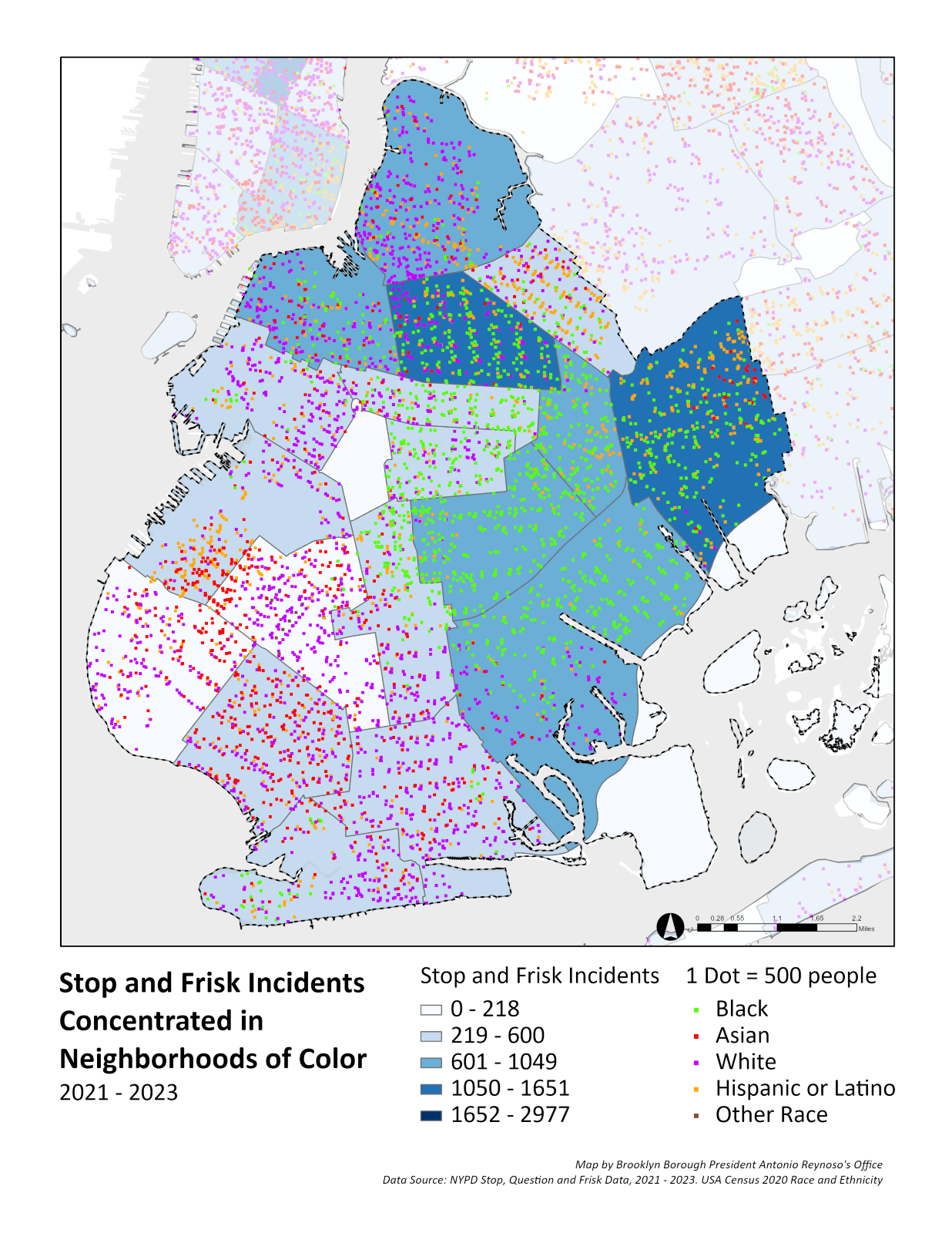
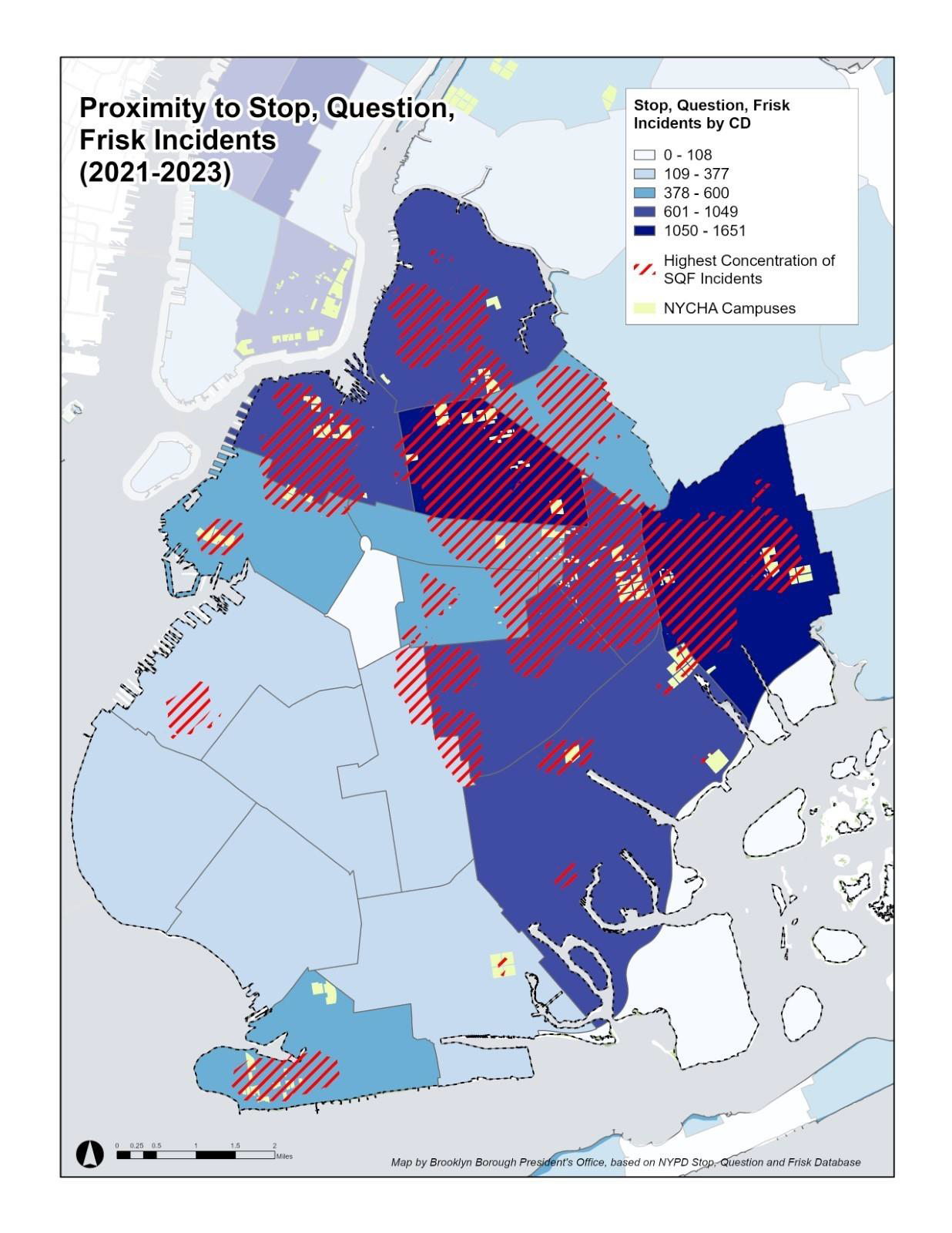
What does this actually look like on the ground? My office analyzed NYPD Stop-and-Frisk data from 2021 to 2023 and found over 11,400 recorded incidents in Brooklyn during this period. While Black residents make up only 34% of Brooklyn’s population, they accounted for 70% of those stopped. Furthermore, 44% of people stopped were under 24 years old, highlighting the practice’s significant impact on youth. The maps below show the geographic breakdown of these stops in Brooklyn. As you can see, they are overwhelmingly concentrated in neighborhoods of color and adjacent to public housing developments.
Unsurprisingly, this contributes to poor perceptions of police within these communities. In a recent survey conducted by Communities United for Police Reform, 56% of people in highly policed communities said that at times they feel unsafe with police around, 54% reported having had unwanted police contact, and 70% said they feared calling or approaching the NYPD for help because it would make the situation worse or lead to unnecessary violence. Alarmingly, survey respondents also described high levels of police contact involving direct experiences of physical, verbal, and sexual/gender-based abuse: 71% experienced varying degrees and forms of harm by the NYPD, and 24% witnessed police threaten to kill someone.
This violent and racist policing contributes to a much broader public health and mental health crisis. The most heavily impacted neighborhoods in terms of policing also have among the lowest life expectancies, highest rates of poverty, highest rates of food insecurity, and highest rates of maternal mortality. Persistent police presence is linked to higher rates of psychological distress. A 2016 article on the impacts of Stop-and-Frisk on New Yorkers states that people who live in areas with high levels of police presence who undergo Stop-and-Frisk have more “psychological distress and more severe feelings of nervousness …. and worthlessness.”
It is deeply frustrating to me, as an elected official and a former Councilmember, that the NYPD continues to ignore the Council’s efforts to change these practices and to hold them accountable for following the law. As a Councilmember, I was proud to champion the Right to Know Act. These two bills, which became law in 2018, aimed to improve accountability and transparency during police interactions by requiring officers to obtain voluntary and informed consent to search someone without cause; and to provide identifying information to people they stop, including the officer’s name, rank, and a business card.
However, my office’s analysis of Civilian Complaint Review Board (CCRB) allegations suggests that compliance with these laws has been inconsistent. Since its implementation, New Yorkers have filed over 900 complaints to the CCRB alleging violations of the Right to Know Act, including officers refusing to provide a business card, obscuring their shield number, or failing to state their name. Notably, the precincts with the highest number of these complaints coincide with those areas that also experience the greatest concentration of Stop-and-Frisk incidents. This overlap reinforces concerns about systemic accountability issues in precincts serving predominantly communities of color.
To ensure enforcement of the Consent-to-Search law and to acquire more data about NYPD street stops and investigative encounters, the Council had to pass yet another set of bills, the How Many Stops Act, which became law this year. Local Law 43 Requires NYPD to report on all levels of street stops and investigative encounters, including demographic information of the person stopped, the reason for the encounter, and whether the encounter lead to any use of force or enforcement action. Local Law 20 requires NYPD to report on instances in which an individual denies consent to be searched, and information pertaining to circumstances involved in such attempt to obtain consent.
Yet once again, NYPD compliance with the law is in question, this time due to their lack of compliance with these reporting requirements. For example, despite the law’s language being clear that data reported must be disaggregated, the NYPD’s early reports group ages together, and there is no data reported at all on gender despite it being one of the mandated categories. What we do know from the data reported is that NYPD’s patterns of discrimination persist, with the 75th Precinct in Brooklyn – where 97% of the population are people of color – has the highest number of Level I and Level II encounters of any precinct in the city.
I want to end by restating a point I have made many times – that the safest communities are the most well-resourced communities, not the communities with the most police. While the NYPD gives lip service to addressing quality-of-life concerns by creating a “Community Response Team” that the Office of the Inspector General said “risks non-compliance with the law, ethical breaches, and negative policing outcomes” due to its lack of transparency, I encourage the Council to work on addressing actual quality-of-life concerns – access to affordable healthcare and mental health services, healthy food, safe and affordable housing, and well-paying jobs, to start. And please continue to shine a light on the NYPD’s illegal and deeply troubling practices. Thank you.